
Integrating Urgent & Emergency Care
The ambulance emergency and urgent care service specification

The purpose of the ambulance emergency and urgent care service specification is to set out the expectations for ambulance services in 2026/27. The specification has been designed for use by ambulance services and commissioners when commissioning the regional ambulance service.
The ambulance service is a statutory provider and is an important health resource for the population. For many people who dial 999, the ambulance service is often the first point of access to health care. The core function of the ambulance service is to provide an emergency response to those patients who have a life-threatening emergency and respond to major incidents. Ambulance services will also provide support to patients with urgent care needs, which may include directing them to a service that can best meet their needs.
NHS ambulance services are supporting the ‘left shift’ agenda; moving care closer to home, working within more joined up, person centred care in the community and reducing reliance on acute care. Ambulance services are supporting an increasing proportion (approx. 46 – 50%) of patients who have called 999 to be cared for at home, or within the community, because of the transformation and improvements they have delivered.
See how regional ambulance services are integrating provision at all levels within their health systems – from national to neighbourhoods: implementing the 10-year plan – see our Vision page
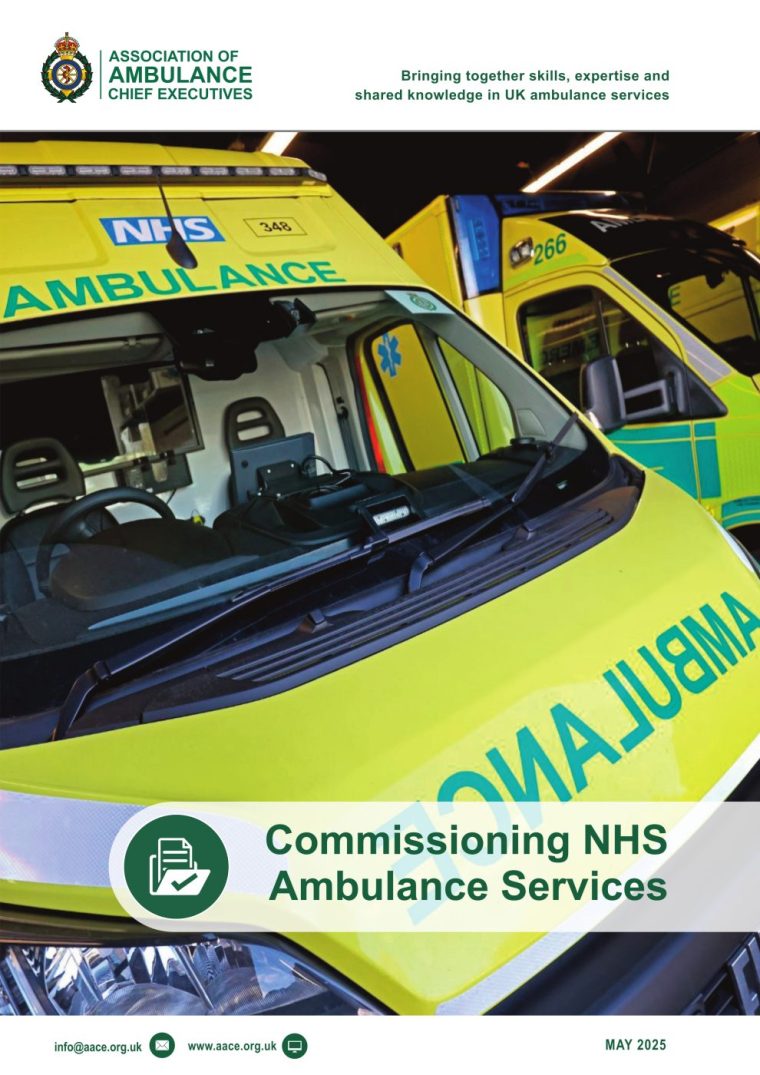
Commissioning of NHS ambulance services (May 2025)

This position paper, developed by the Association of Ambulance Chief Executives (AACE), aims to provide strategic input to the ambulance commissioning review scheduled for 2025/26 and implementation in 2026/27, as outlined in NHS planning guidance.
 The ambulance sector views this review as a pivotal opportunity to resolve longstanding commissioning barriers to optimal patient care delivery. This paper presents a unified sector position to inform the development of a commissioning framework that enables ambulance services to fulfil their evolving role within integrated healthcare systems.
We acknowledge that commissioning reform alone is insufficient without parallel operational transformation.
We also highlight that the experiences and examples shared in this position paper are not reflected across all ambulance services, and that this should be taken as an opportunity to level up and consolidate our approach whilst addressing the challenges. We are aware of the current national challenge and fluidity of the context in which this paper is published.
We hope it can be used as a starting point to a constructive and collaborative discussion to enhance urgent and emergency care (UEC) effectiveness and productivity, improve patient outcomes, and reduce inequalities.
On 22 January 2025, the Association of Ambulance Chief Executives (AACE) was part of a group of six high-profile health bodies to jointly publish a new set of proposals for significantly reforming urgent and emergency care, to help inform the Government’s upcoming UEC Improvement Plan and 10-Year Health Plan.
>> Influential figures call for ‘single UEC service’ for NHS | News | Health Service Journal (requires subscription to HSJ)>> Exclusive: Expert review concludes NHS ‘got winter it prepared for’ | News | Health Service Journal (requires subscription to HSJ)
Collaboration with all partners, in secondary, primary, mental health and community, and our wider stakeholders in our communities, for the benefit of patients, requires greater integration of the urgent and emergency services we, between us, provide.
By acknowledging the potential for change and co-designing system UEC strategies with all partners and stakeholders, the ambulance sector can play a pivotal part in helping to alleviate many of the system pressures and capacity issues, rather than contributing to them.
In this Getting It Right First Time (GIRFT) Further Faster session (July 2024) we discussed:
- the interface between ambulance and hospital care,
- the impact of hospital handover delays on patient care,
- what the alternatives are to conveying patients to emergency departments (and the limitations of these),
- how we aim to get patients to the right care, first time when someone calls 999 and,
- how integrated care-coordination at the point of call is helping us to get it right with that single touch point,
- how we can identify where, if systems can address critical gaps in services, we can improve outcomes and experience for patients
Download the slide deck below: