How ambulance services are using public health approaches to reduce health inequalities
Integrated Care Systems (ICSs) have four core priorities to deliver in relation to reducing health inequalities, which include the requirement to:
- Improve outcomes in population health and healthcare
- Tackle inequalities in outcomes, experience and access
- Enhance productivity and value for money
- Help the NHS support broader social and economic development
Every day, ambulance services take thousands of calls from the public and see first-hand that in our least well-off neighbourhoods people are dying years earlier than they should.
The Association of Ambulance Chief Executives (AACE), working on behalf of the UK’s NHS ambulance services, has brought partners together to develop and launch a national consensus approach to support ambulance services and their Integrated Care Systems (ICSs) in reducing health inequalities.
The consensus agreed by major health organisations including NHS England (NHSE), the Office for Health Improvement & Disparities (OHID), the College of Paramedics (CoP), NHSE Workforce, Training and Education (NHSE-WTE, formerly Health Education England), NHS Providers (NHSP) and NHS Confederation (NHSC), who host the ICS Leads Network, was launched on 8 June 2023.
In developing the consensus approach we have considered how everyone working in the ambulance sector can contribute to reducing health inequalities, both as providers of care and as anchor institutions within their regions.
 Strengthening the role of the ambulance sector in reducing health inequalities:
What we know
This publication reviews key national policy drivers for reducing inequalities alongside research, expert stakeholder knowledge and case studies to present an overview of what we already know about the ways in which the ambulance sector can make a positive impact on health inequalities as a key player within the wider system.
 Strengthening the role of the ambulance sector in reducing health inequalities:
National consensus statement and next steps
The consensus statement and next steps set out a shared commitment to strengthening the role that everyone working in the ambulance sector can play in reducing health inequalities.
It underlines common goals and objectives across partners in a concerted attempt to balance the playing field for all service users and overcome the challenges of health and social care inequality.
 Strengthening the role of the ambulance sector in reducing health inequalities:
Implementation toolkit
(updated Sept 2026)
An interactive toolkit has been developed containing information and links to further resources that support a focus on embedding a public health approach within the ambulance sector with the aim of reducing health inequalities experienced by the populations and communities we serve.
We have also developed a Maturity Matrix (updated Sept 2026) for ambulance services to undertake a self-assessment process and gauge their progress against key objectives in reducing health inequalities. You may wish to use this in conjunction with NHS Confederation’s Health Inequality Assurance Framework: a self-assessment improvement tool for integrated care boards.
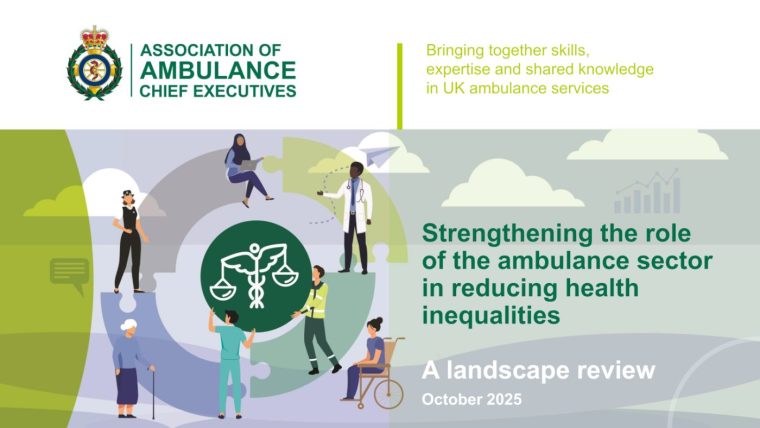 Strengthening the role of the ambulance sector in reducing health inequalities:
Landscape review
As part of the development of the national consensus statement, we committed to conducting a review after a two-year period to ensure that the correct actions remain in place to deliver the commitments made. This landscape review outlines the currently evolving policy context, views from ambulance services and partner organisations on the extent to which implementation of the principles of the consensus statement has been achieved, together with recommendations for further progress and next steps.
Further information:
Webinars
View our range of webinars here.
Training resources
View additional training resources here.
 Discussion paper:
Developing a Public Health Approach within the Ambulance Sector
This resource describes the importance of public health and prevention within the ambulance sector, what is meant by a public health approach, and the ways in which this agenda can be progressed by staff and volunteers at all levels throughout ambulance trusts and collaboratively across systems.
If you have any questions about this programme of work, please contact ruth.crabtree@nhs.net or hilary.pillin@aace.org.uk