How can we better demonstrate the impact of Community First Responder volunteers on the ambulance service, and what policy recommendations can we make based on this analysis?
This national research project was undertaken by Kings College London in 2025. Its aim was to develop the national evidence base for the important role of ambulance Community First Responder (CFR) volunteers.
 This research investigated the impact of Community First Responders (CFRs).
It was undertaken between February and April 2025 by Kings College London with funding from the National Institute for Health and Care Research (NIHR) and support from the Department of Health and Social Care (DHSC) and the Association of Ambulance Chief Executives (AACE).
The research included quantitative research across five ambulance trusts: East of England (EEAST), North West (NWAS), South East Coast (SECAmb), South West (SWAST), and Yorkshire (YAS) and in-depth qualitative research at EEAST and YAS.
It aimed to better understand the impact of volunteering on ambulance services and the experience of volunteers. It then sought to make recommendations around recruitment and deployment of CFRs as well as highlighting areas for further study.
The research highlights the central role that CFRs play in community-based care and community resilience. This is especially important in light of the shift to community outlined in the NHS 10-year plan.
Key findings include:
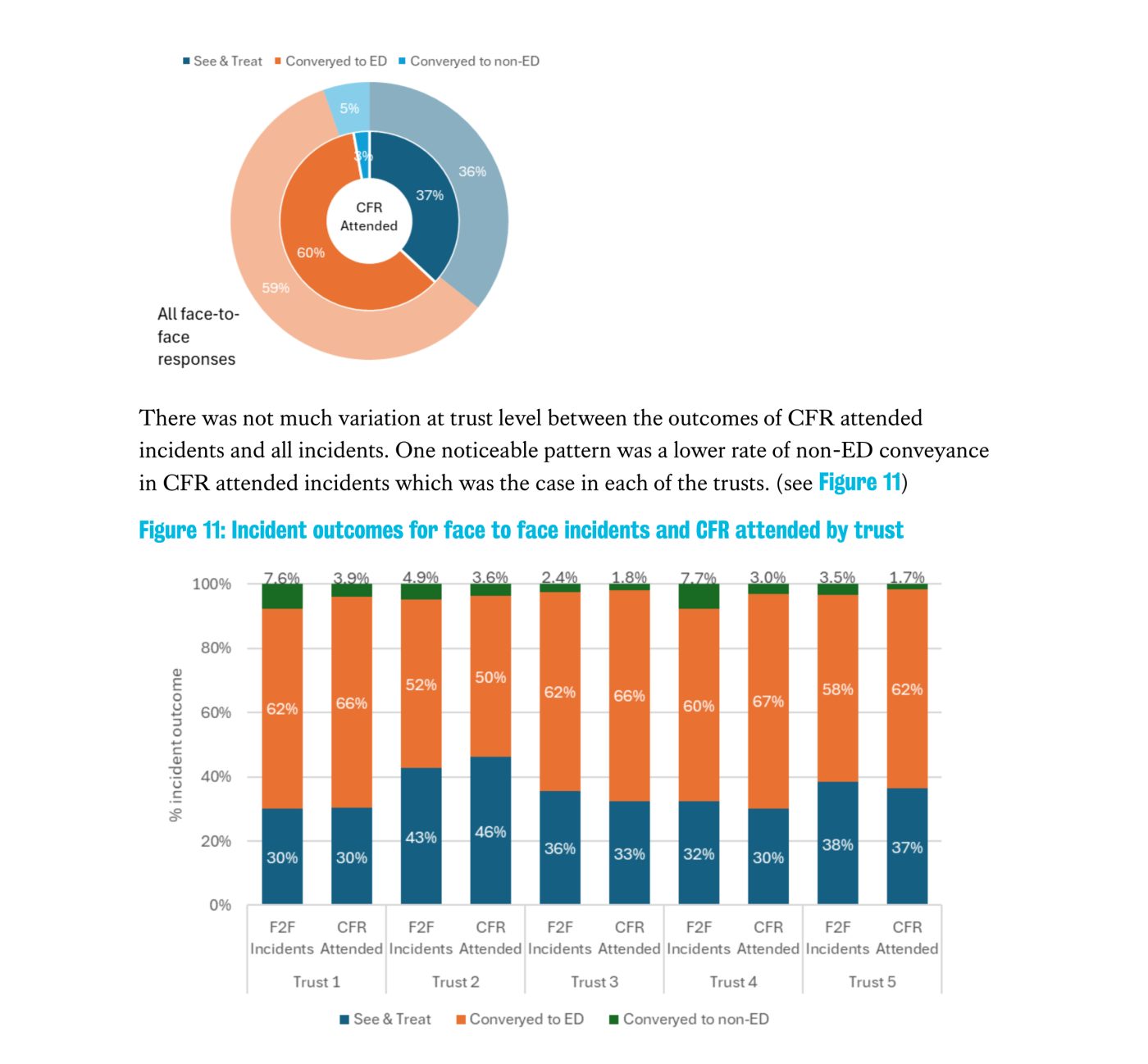
- CFR attendance reduces the response times for category 2 and category 3 incidents. In addition, where CFRs are first on the scene, category 2 incidents have a slightly higher See & Treat rate (i.e. patients are assessed at the scene but not conveyed to hospital) and a lower conveyed to non-ED rate. Where CFRs are the first on the scene, category 3 incidents have a slightly higher See & Treat rate and a lower conveyed to ED rate.
- This may be indicative of more effective use of ambulance resource overall, and limited data suggests an equivalent saving of one resource for every five incidents attended by a CFR for category 3. Note: CFRs only operate under close clinical supervision and any decisions on conveyance are undertaken by clinical ambulance staff.
- CFR attendance is particularly impactful in rural areas. CFRs attend a greater percentage of rural incidents as a proportion of overall ambulance response. This focus leads to faster response times and higher community resilience in these areas. This may help to reduce inequalities linked to proximity to services.
- However, this long-standing rural focus means that CFRs are proportionately less active in the top 20% most deprived areas of England (by Indices of Multiple Deprivation), which are predominantly based in urban areas.
- Over time, the CFR role has become accepted by paid ambulance staff. It is increasingly valued by them and seen as complementary to, rather than conflictual with, existing professional jurisdictions.
- The CFR role brings volunteers fulfilment, new challenges and the ability to connect with other members of the community at times when this is vitally needed. CFRs increasingly feel valued by paramedics and other ambulance staff.
- To operate effectively, CFRs require a significant leadership commitment from ambulance trusts. They require training and wider resources – this is not a free service. There are particular resource challenges faced by NHS managers overseeing CFRs.
- The CFR role could be further developed and improved by better and more consistent data collection at both regional and national level – including moving from paper to digital record keeping.
Recommendations for further study:
- Lack of patient voice. The research team hoped to speak with patients but this was not possible. Capturing patient feedback systematically will support trusts to properly measure and articulate the impact of CFRs on patient experience and care.
- Some CFRs feel under-utilised and believe there is opportunity for more regular deployment when they are logged on for calls. There was high variation in the relationship between hours logged, active CFRs and average incidents attended in the quantitative data. Follow-up work could be done to better measure the productivity of different CFR services and the impact of dedicated CFR dispatch desks.
- More consistent data collection at trust and national level could augment innovation and service improvement. For example, further research needs to be conducted to understand the ways in which CFRs impact outcomes and save resources at category 2 and category 3 incidents. The scope of this study enabled only tentative conclusions.