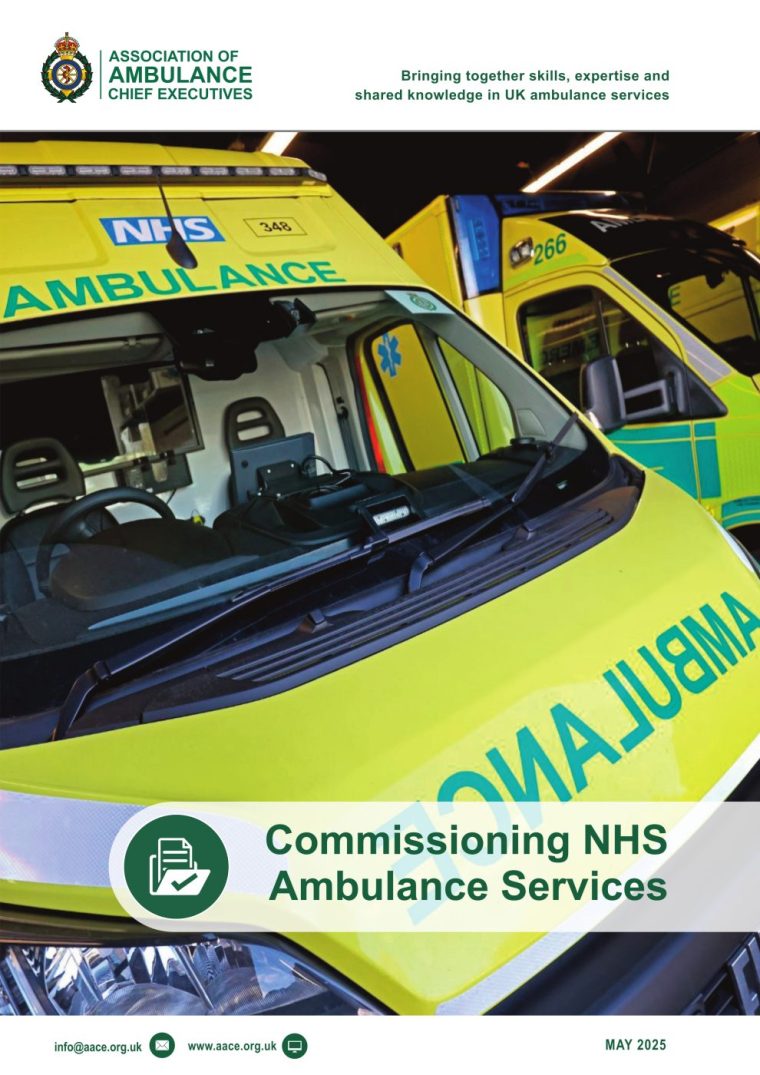
 In May 2025, the Association of Ambulance Chief Executives (AACE) published a strategic position paper to inform the national ambulance commissioning review scheduled for 2025/26, with implementation expected in 2026/27.
The review, led by NHS England, seeks to fundamentally reform how ambulance services are planned, funded and integrated across England’s healthcare system.
AACE’s paper highlights the urgent need for a more coherent commissioning framework – one that reflects the ambulance sector’s expanding role in coordinating urgent and emergency care (UEC) and aligns with the ambitions set out in the NHS’s 10-Year Health Plan.

Why change is needed
The current model, where one Integrated Care Board (ICB) commissions services on behalf of others, has been widely criticised for:
- Fragmented governance across regions.
- Limited strategic coordination.
- A tendency to prioritise local sustainability over system-wide improvement.
These issues have hindered service innovation and led to inconsistent outcomes for patients.
The commissioning review
The 2025/26 review presents a major opportunity to fix longstanding commissioning challenges and support ambulance services in delivering more equitable, integrated care. Key anticipated outputs include:
- A national commissioning specification for implementation in 2026/27.
- Stronger alignment with the 10-Year Health Plan’s pillars: prevention, digital transformation and community-based care.
- Enhanced support for neighbourhood health services and urgent care coordination hubs.
Targets and reform priorities
The review is part of wider NHS reforms aiming to improve urgent care performance, including:
- Reducing Category 2 ambulance response times to an average of 30 minutes.
- Ensuring 78% of patients are seen within four hours in A&E by March 2026.
Commissioning reform will play a key role in achieving these goals by reducing unnecessary callouts, improving handovers and strengthening care coordination across settings.
AACE’s commissioning framework proposal
AACE’s paper sets out a multi-tiered commissioning model designed to improve consistency, accountability and outcomes:
- National level: Standardised specifications and outcome frameworks.
- Regional level: Strategic, multi-year commissioning through delegated authority.
- Local level: Collaborative commissioning aligned to population health needs.
This model supports the ambulance sector’s transition from emergency responders to system-wide UEC coordinators – with digital integration, neighbourhood models and prevention at the core.
Sector perspective
The AACE paper acknowledges that ambulance services are at different stages of commissioning maturity and calls for levelling up across the board. It also emphasises that commissioning reform must be accompanied by operational transformation to fully realise benefits.
Anna Parry, Managing Director of AACE, said:
Changing the way ambulance services are commissioned must be a priority if we are to enhance our sector’s contribution to NHS urgent care, improve patient outcomes and deliver consistently high-quality care.
This position paper is intended to inform and guide Government and NHS stakeholders as they consider what is next.
AACE invites further collaboration and dialogue from all interested parties to ensure the commissioning review delivers meaningful improvements for patients, ambulance teams and wider system partners.
For more information please contact hilary.pillin@aace.org.uk